Homage and fealty
The Last DuelHomage and fealty was the ritual and sworn obligation through which a vassal placed himself in a lord’s service. The kneeling, joined hands, kiss, and oath made feudal dependence visible and binding. The book traces the practice from the bonds that organized lordship in France to the judicial duel, where oaths again placed lives and reputations at stake, but in open opposition rather than mutual service.
The Feudal Bond
A vassal was any man sworn to serve another. The relationship joined people across levels of the feudal hierarchy: a knight might hold one or two fiefs from a greater lord, while a count or duke might hold many lands in exchange for service. The vassal knelt with clasped hands between his lord’s and pledged himself; he then rose, received a kiss on the mouth, and swore lifelong service. The ceremony expressed mutual bonds that held society together, but its obligations were unequal in reach and consequence: land and protection were joined to service and dependence.
Jean de Carrouges and his father performed this ritual first for Count Robert of Perche. In the count’s court at Nogent-le-Retrou, they did homage to their younger lord and swore fealty. For the following decade they attended him at court, paid annual rents, helped enforce his decrees, and answered military call-ups against the English. Their service was not an abstraction; it connected their standing and prospects to the person who controlled their fiefs and could summon them to act.
A Change of Lord
When Count Robert died without an heir in 1377, control of his lands and castles reverted under feudal law to his overlord, King Charles V. The king granted Perche to Robert’s older brother, Count Pierre of Alençon. Jean and his father were therefore bound to a new lord almost overnight. They had to renew homage and fealty, placing their lives and destinies largely under Pierre’s control. The transfer shows how the personal form of the bond operated within a larger legal order: the vassals’ allegiance changed because the rights to the land had passed to a new lord.
Oaths as Legal and Sacred Acts
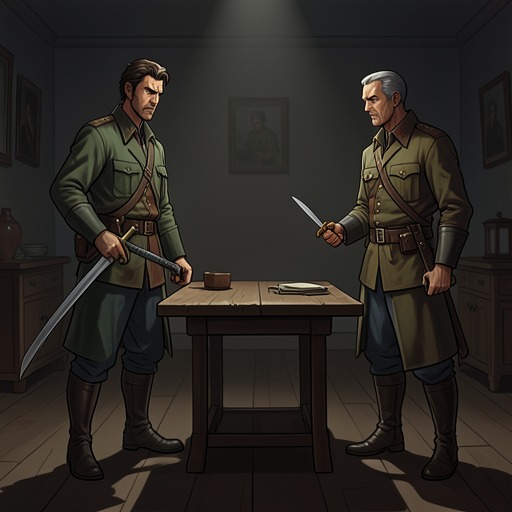
The judicial duel drew authority from a different but related use of sworn words. A noble dissatisfied with a verdict could appeal to the king and challenge his opponent to combat. The procedure was meant to determine which party had sworn falsely; its result was widely believed to disclose the truth through God’s will. Unlike a duel fought over an insult, it was a formal legal procedure, authorized within the king’s jurisdiction.
Before the combat between Jean de Carrouges and Jacques Le Gris, priests placed an altar at the center of the field, covered it with a gold cloth, and set upon it a silver crucifix and a prayer book opened to an image of Christ’s Passion. The sacred objects framed the duel as divine judgment. The combatants swore that their causes were just and that they relied on the justice of their cases, not magical aid. In their final oath they knelt face-to-face, touched the crucifix, and clasped one another’s bare left hands as they each affirmed the truth of his accusation or defense. The left-handed clasp marked the bond as hostile: in other mutual oaths, including those associated with marriage and vassalage, the parties held the right hand.
Royal Judgment and the Limits of the Custom
The duel’s appeal to divine judgment did not displace earthly authority. The Parlement of Paris authorized the combat in the king’s name, and King Charles VI presided as judge. He delayed the contest so he could attend after returning from Flanders, and proceedings did not begin until he had taken his place in the royal stand. Sacred ceremony and royal procedure thus reinforced one another: the outcome was presented as God’s verdict, while the king and court organized and witnessed the process through which that verdict would acquire legal force.
The distinction between the two kinds of oath is central to the concept. Homage pledged service and established an enduring bond between lord and vassal; the duel’s joined left hands bound sworn opponents to a claim whose outcome could mean death. After Jean de Carrouges killed Jacques Le Gris, the defeated man’s body was carried to the executioner and taken to Montfaucon, in keeping with the duel’s treatment of the loser as guilty. The Parlement-authorized combat was its last judicial duel. Although later appeals for trial by combat reached the Parlement, none resulted in permission to fight. The ritual of fealty belonged to a continuing structure of lordship; the duel’s use of sacred oaths as a judicial test reached a contested, consequential endpoint.